
Casey Cook | Sometimeish Exhibition Review
Casey Cook: Sometimeish at Oneoneone
Review by Amy White
September/October 2026
While I wasn’t lured by the recent hype around Christopher Nolan’s blockbuster film The Odyssey (2026), and as of this writing I haven’t seen it, it is nevertheless one of the scores of cascading nautical associations that arose for me upon seeing Casey Cook’s compelling boat paintings at Oneoneone. (Let’s just put a pin in the ambient/ancient/archetypal seafaring aspects of this Homeric pop cultural moment as deep background.) The show’s title, Sometimeish, is Caribbean patois often used to describe someone who is unpredictable, but given the artist’s stated personal narrative(s) in relation to this body of work, it has broader implications about the unpredictability and fragility of lived existence and the malleability of time itself.
The mythology surrounding the show starts with a photo that captured Cook’s imagination - a storm-wrecked vessel on the tiny Grenadine island of Carriacou. The handmade boat “Laser” represented a local lineage of craft and care. Even in its wrecked state, and despite the inherent remove of digital representation, the vessel seems to have reverberated for the artist with what Walter Benjamin described in “The Work of Art in the Age of Mechanical Reproduction” as its aura. Cook’s fascination with the vessel ultimately led her to visit the island, one of two interrelated experiences that clearly mark these works. The other was the artist’s experience seeing her father through hospice to the end of life. Talk about an odyssey.
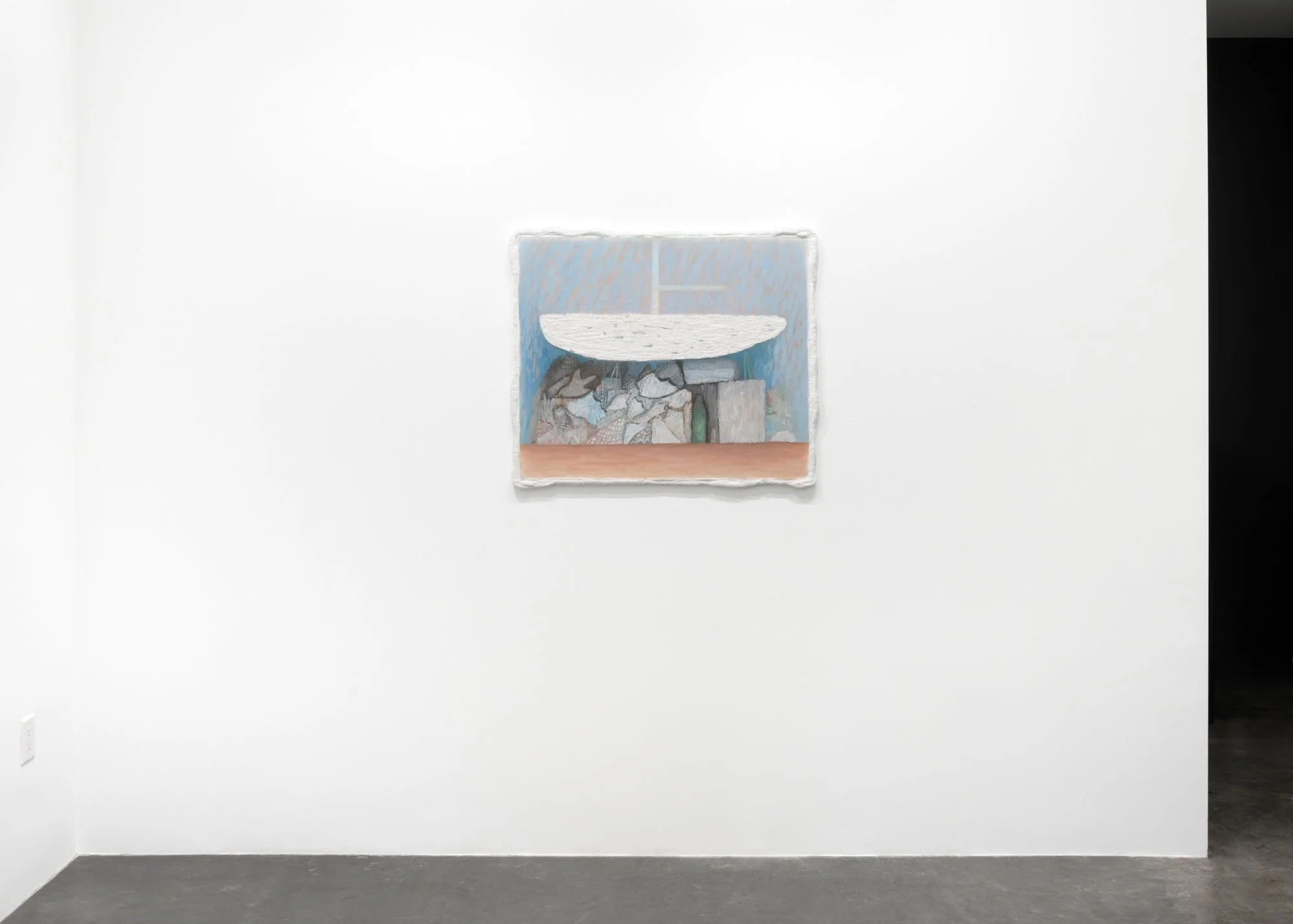
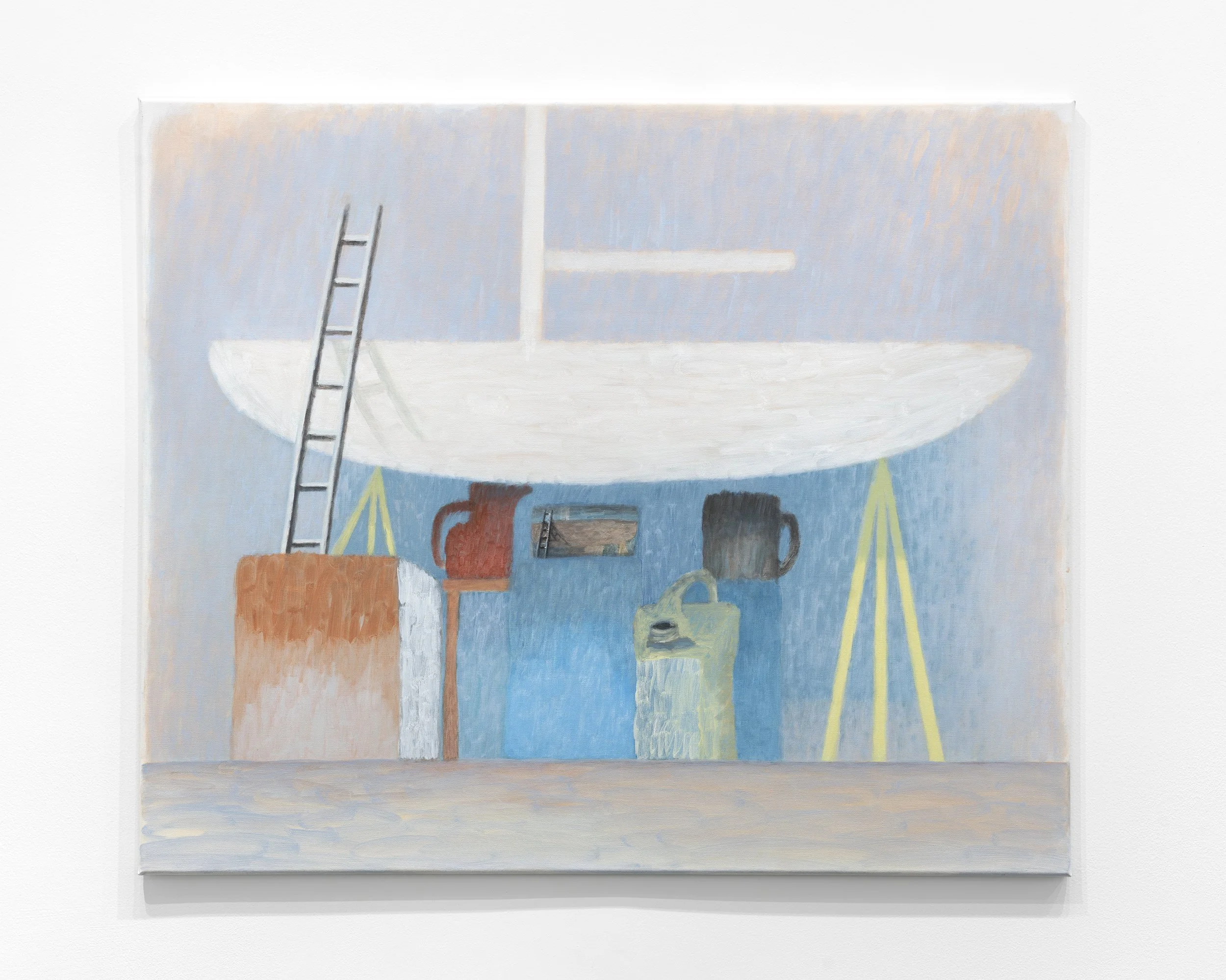
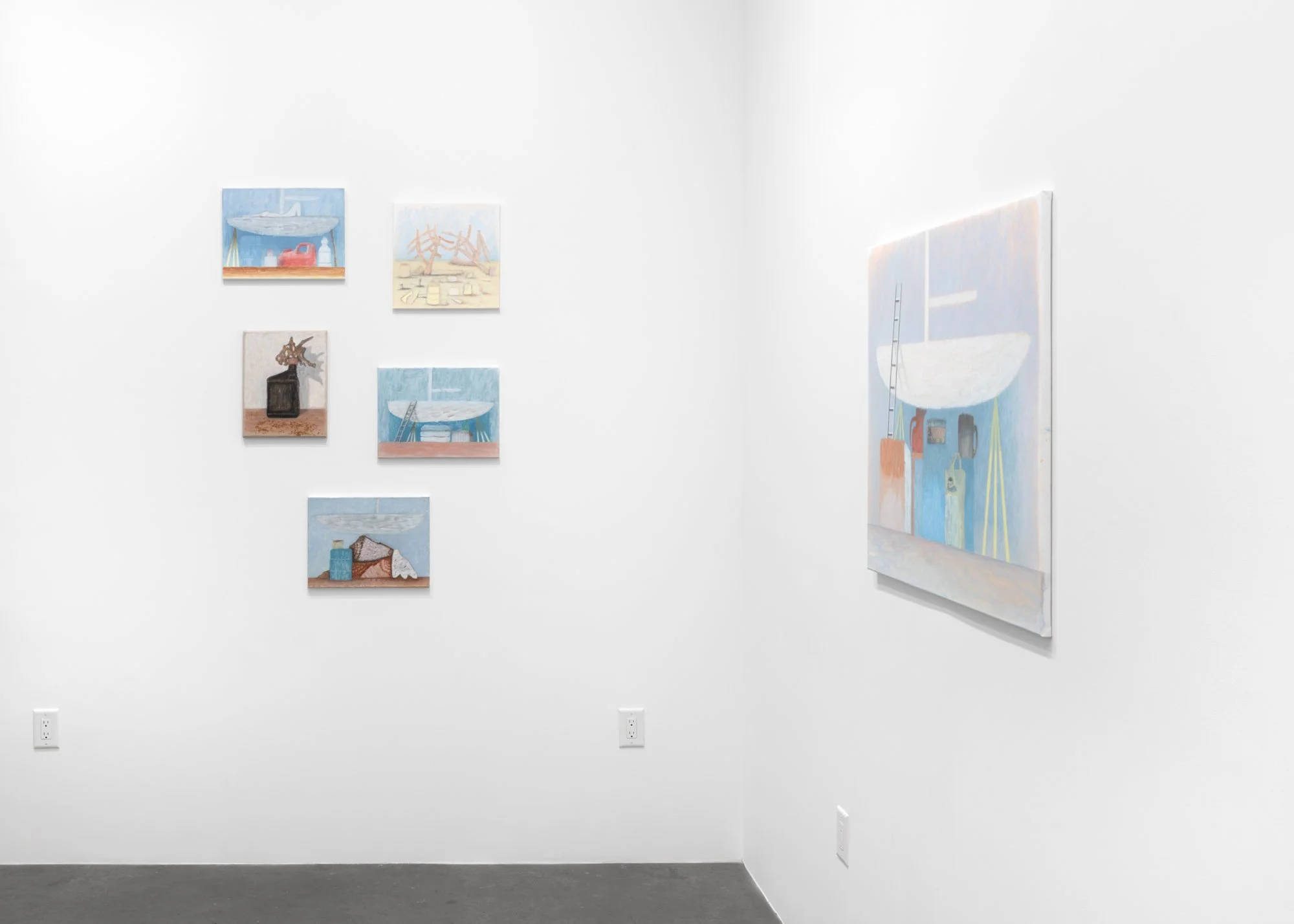
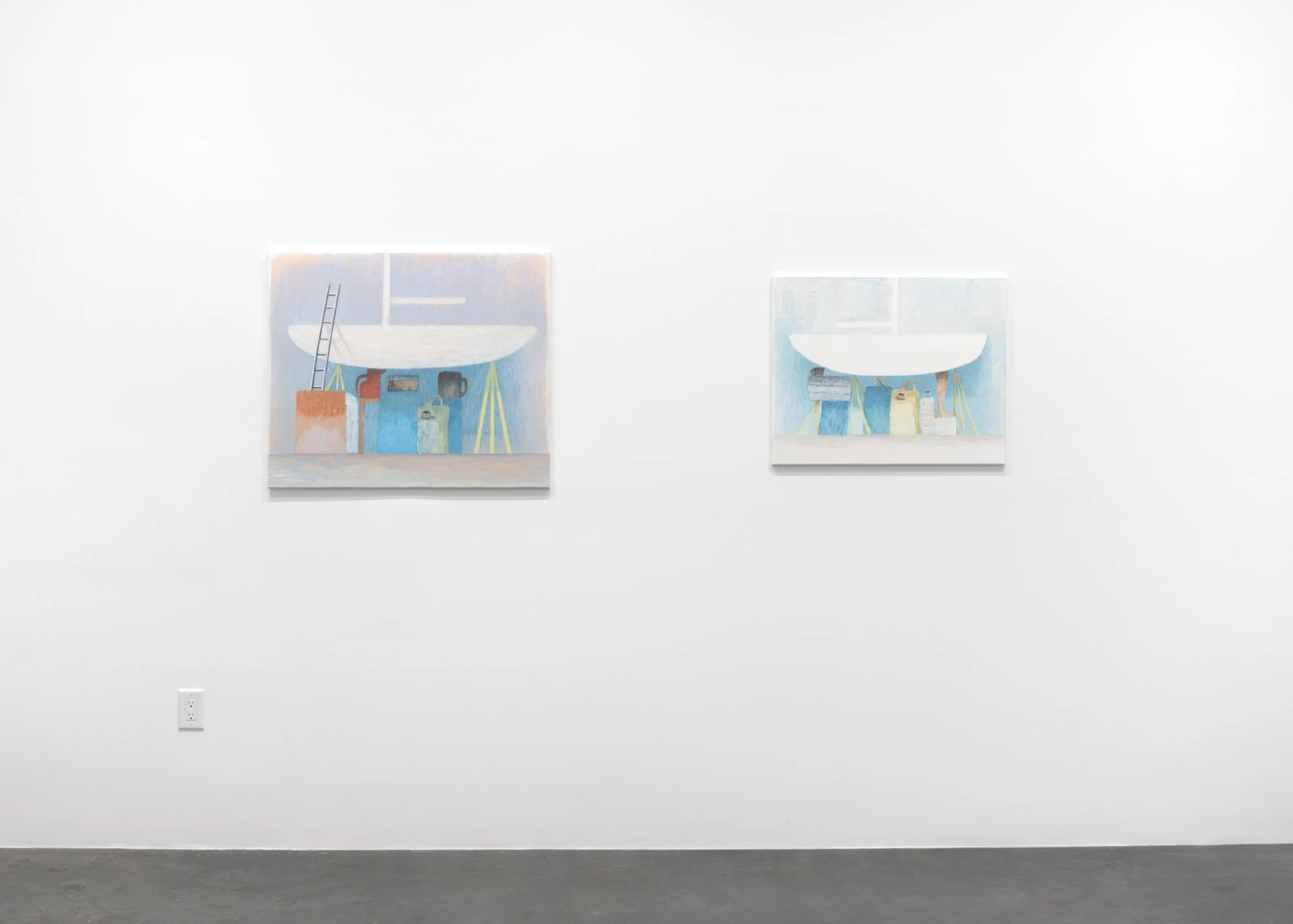
My first take on the paintings was their sensitivity, quietude, and conveyed patience of facture. The focal image of most of the paintings (centrally positioned within interior spaces that appear to be a repair shop or artist’s studio) is a single boat figuration. These forms are paired down to their simplest components, symbolic structures suspended within and among depictions of discernable objects and undefined abstractions. (Cook liberates herself from a compulsion to illustrate and opts for painterly decision making rather than narrative linearity – the temporal implications here are relevant). In the paintings, the boats are always shown elevated on some kind of structure for repair; the idea of elevation (and its possible esoteric corollary, transcendence) is underscored by the occasional presence of ladders that feel like metaphoric counterpoints to the boats. Boats and ladders = human-made structures that expand our range of motion horizontally and vertically and literally reshape what is possible in how we navigate through (time and) space.
Cook’s paintings emphasize a flattened visual field and a muted palette, immediately bringing to mind Philip Guston and Giorgio Morandi – with the slightest inflection of Saul Steinberg’s calligraphic wit. When I got home I immediately searched for two books: Jan Verwoert’s Bas Jan Ader: In Search of the Miraculous, which speaks to a range of projects by that essential conceptual artist and culminates in his final great work of the same title, through which the artist perished at sea (Afterall Books / The MIT Press (2006)), and Becca Albee’s conceptual artwork in book form, Folly Gone Forward (Cedar Mountain Books (2007)) that pays direct homage to Ader.
Other cascading associations flowed to a cultural history of boats as couriers of the underworld, specifically Wolfgang Laib’s skyward scaffolds on which rest life size beeswax boats, and Satch Hoyt’s Celestial Vessel (2010), a luminous ruby red boat suspended in space made entirely of translucent vintage 45 discs (realized when the artist was in residence at the Nasher Museum of Art at Duke University in 2009).
The sense of time in the work is palpable – verging on circadian – as if Cook’s nervous system had recalibrated to life on a small island, evident in a careful laying on of paint, a patient building of lines, textures, shadows. Artist/curator Joy Drury Cox noted that the repetition of the boat forms (over a dozen among the paintings on view) also speak of temporality, the idea of staying or residing with a single idea, theme or image in different lights at different times of day (think Monet’s haystacks). Cook traveled to Carriacou so she could literally stay or reside with the thematics that called to her. There is a chills-inducing story, a remarkable coincidence whereby the newly repaired Laser was sent to her part of the island to deliver art supplies she had ordered, that indeed verges on the Miraculous.
Some of the paintings include embedded images of a solitary nude or semi-clad female figure; it took me a while to even notice these presences. They register as incidental, casual, vulnerable: they say something about what it means to persist, to be in the world, to get on with the work of sentient being.
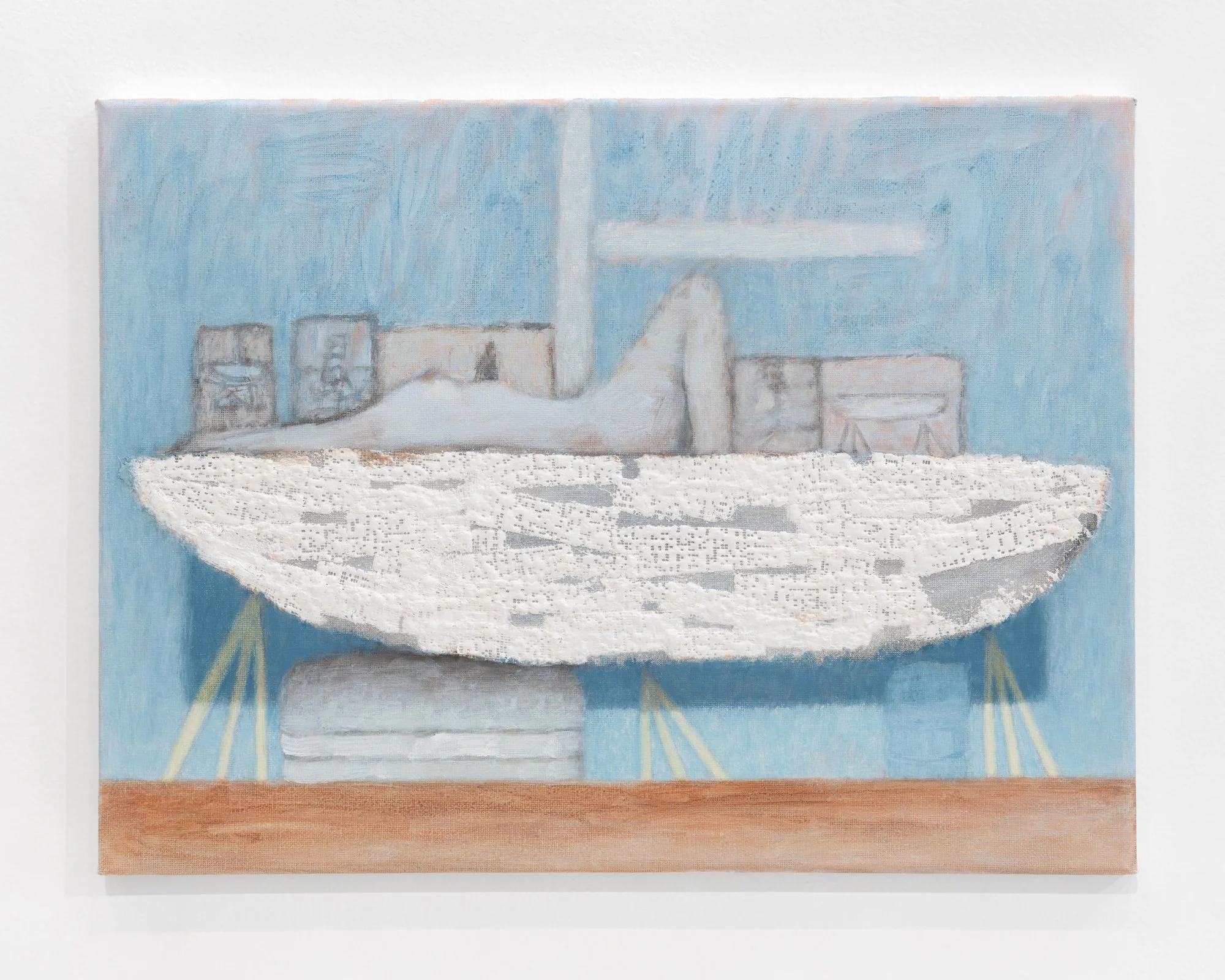
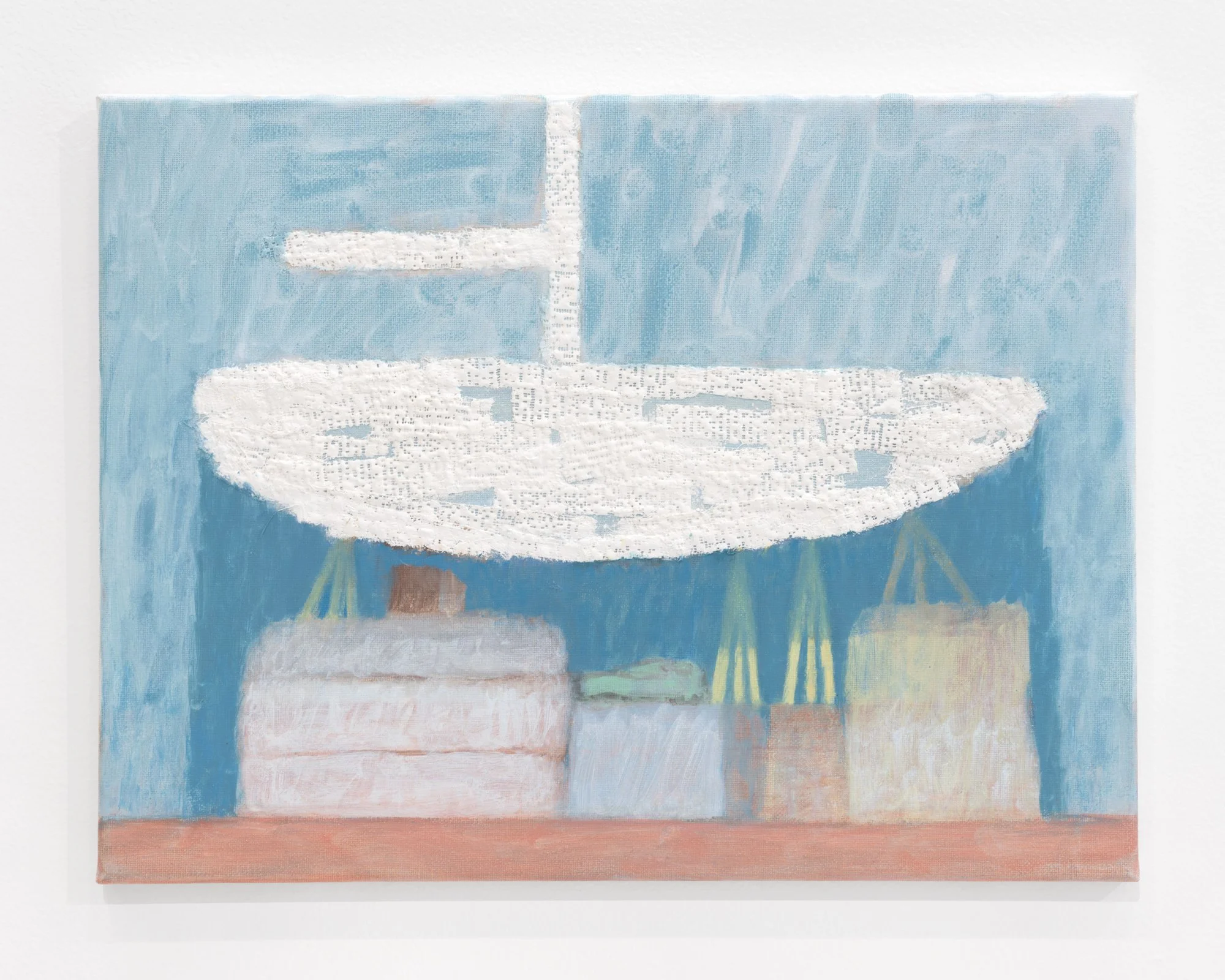
In this regard, an ethos and echo of repair intone throughout the show – in terms of the literal repair of the handmade boats and the palpable sense of the handmade, the artist’s hand, in the paintings. They are also present in the subtext of losing one’s parent – the heightened stakes inherent in works made during such a passing. In this light, the repeated production of boat paintings (many of which feature images of boat paintings within them) speak to the necessary repetition of the grief process – the need for repetition in making sense of loss and thereby repairing something.
Thus, Cook’s use of bandage material within the compositions and surrounding/framing some of the works serves as a literal/subliminal symbolics of repair and its temporal imperatives, crystallized in the adage “Time heals all wounds.” At times the private pain of grief may drive us to ask “But how much time?” Cook offers one possible answer: sometimeish.
Endnote:
Yes, there is death in this business of whaling—a speechlessly quick chaotic bundling of a man into Eternity. But what then? Methinks we have hugely mistaken this matter of Life and Death. Methinks that what they call my shadow here on earth is my true substance. Methinks that in looking at things spiritual, we are too much like oysters observing the sun through the water, and thinking that thick water the thinnest of air. Methinks my body is but the lees of my better being. In fact take my body who will, take it I say, it is not me. And therefore three cheers for Nantucket; and come a stove boat and stove body when they will, for stave my soul, Jove himself cannot.
Herman Melville, MOBY-DICK; or, THE WHALE. (1851)
About the Author
Amy White is an artist and a writer. Her writing has appeared in Art Papers, Burnaway and IndyWeek as well as in museum catalogs, artist's monographs, poetry anthologies, zines, blogs and overwrought social media posts. She was a recipient of The Creative Capital / Andy Warhol Foundation Arts Writers Workshop and has been a finalist for The Creative Capital / Andy Warhol Foundation Arts Writers grant. White holds a BA in Aesthetic Studies from the University of California Santa Cruz as well as an MA in Art History and an MFA in Studio Art from the University of North Carolina Chapel Hill.
https://substack.com/@parallelarts